 Have you written a self-help book, DIY book, user manual, training book, or some other book that is full of advice? If so, don’t stop when it’s published. In fact, even before you start writing, make plans to use your book to build business. [Read more…]
Your copyright page: Everything you need to know
 Some people say that the first page is the most important one in any book—and that is probably true as a means for hooking a reader. Others say that the cover is the most important. But I contend that the copyright page wins the prize because it’s probably the first page that a librarian, bookseller, or distributor looks at. And that makes it an integral part of your book marketing program.
Many self-publishing authors find the copyright page to be horribly confusing. All that legal language! All those numbers! What does it all mean? [Read more…]
Optical margin alignment
 Some InDesign functions have names that you would never be able to guess, and that makes them really tough to discover and learn. One of these is Optical Margin Alignment (I’m calling it OMA), which is InDesign’s formal name for hanging punctuation. I used to see this effect in other people’s work and then try to imitate it, but I couldn’t because I had no idea what it was called. So this article explains what it is and how to do it. [Read more…]
Calculate book page count using word count
 Wondering how many Word pages equal a book page? You can easily calculate book page count using the word count from your Word document. We’ll explain two easy methods to calculate book page count: 1) use one of our simple formulas as a book page count calculator, or 2) use our InDesign template to experiment with book trim size and type size to accurately determine a page count for books. Use whichever method is easiest for you. [Read more…]
Reference books for book designers
 Ask any book designer about their collection of reference books and you’ll get a long list of the usual suspects: books about design, typography, layout, and grids; dictionaries and style guides; software manuals; and lots of books and magazines kept for inspiration. But which books are indispensable to a book designer?
Live endnotes in InDesign
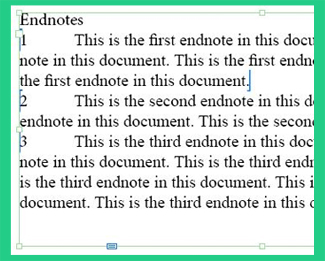 Adobe’s InDesign includes a great feature for book designers—live endnotes. Until now, footnotes and endnotes could be imported from Word to InDesign, but only footnotes continued to be live and linked, allowing us to insert and delete them without messing up the numbering system. Now we have the same flexibility with endnotes! [Read more…]
InDesign footnotes: an alternate typesetting method
 If your book has footnotes, you’re probably using automatic InDesign footnotes in your layout. And that’s great! But what if you compiled your footnotes in a separate Word document or didn’t use the automatic footnote feature in Word or InDesign?
Before Word and InDesign added their automatic footnote features, and well before Fiona and I met each other, we both invented a way—interestingly, the same way—to lay out InDesign footnotes manually for print books. In this blog post, I’ll explain the layout method that we both used—it still works perfectly.
Converting multiple images to CMYK in Photoshop
 Need to convert to CMYK in Photoshop? Let’s say you’re designing and typesetting a book with lots of images. You’ve finished laying out all the pages, and your last task is to prepare the images for print. All of your images have either been scanned or photographed, and therefore they are all RGB color (not CMYK color, as required by most offset printers). And most images are JPGs, although you might have a few PNGs too.
It’s a monumental task to convert each image to CMYK individually. Suppose you have 50+ images, or even 1,500+ images! I found myself in this situation recently, and am sharing with you a quick and easy way to convert all of your images to CMYK at once by batch processing actions in Photoshop. (It sounds complicated, but isn’t.) [Read more…]
Book marketing to libraries: a scheme that really works
 Book marketing to libraries can be tricky, but here’s a scheme we tried that worked for us.
How many people can you count as friends? You will soon find out when you ask for their help with this book marketing technique that works for even the most shy of authors.
With a little work and a big ask, you will soon find your book listed in public libraries all over the country. [Read more…]
Mixing colors for 2-color printing in InDesign and Photoshop

In my previous blog post, I mentioned mixing two colors to use for 2-color printing. So now I’m back to explain how to do that in InDesign, plus how to make a 2-color photo (duotone) in Photoshop. And I’ll let you in on the simple way to make a fake duotone right in InDesign, too.
So let’s start with what we can do in InDesign. [Read more…]
- « Previous Page
- 1
- …
- 4
- 5
- 6
- 7
- 8
- 9
- Next Page »

