 Below you'll find links to all the information about book design that’s available on our website,
  Want to design a workbook? Who uses those any more?
Lots of folks, actually. Even though there are apps for practically everything these days, children still enjoy workbooks for mazes or drawing or learning practically anything. Adults can use them for recording their latest bird find or geocaching location, or for word or number puzzles, for instance. A coloring book can be considered a workbook, too.
We’ll help you design a workbook that will work well for your audience.
 Why, you might ask, is the coauthor of a book about InDesign reviewing a direct competitor, Affinity Publisher?
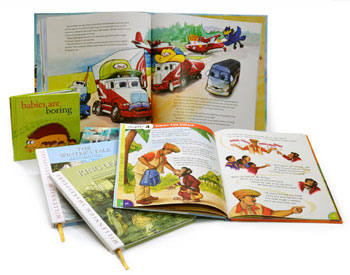 Children’s picture books are fun to design! They’re colorful, full of images, and everything is packed into a small number of words and pages.
 Coffee table books. Are they a blast from the past? No, actually, folks are still publishing them, and you can, too. Do you have an idea for a coffee table book of poetry and photography? About a specific artist or a place you love? About your local history, or something completely different? With good planning and design, your book could become very successful.
  Every book has front matter elements. A title page and a copyright page are absolutely essential. But many manuscripts have arrived at our desks with a jumble of other pages that are misnamed, out of order, or sometimes simply puzzling. So I’m going to straighten this out for all you indie authors and publishers, because a professional-looking front matter is the best beginning for any book.
  Do you use a layout grid? A few months ago, I saw a survey on Twitter for designers. The one multiple choice question went something like this:
 The term book arts encompasses an endless variety of books, usually handmade or produced in a limited edition. Included are all kinds of artists’ books, ezines, graphic novels, printed ephemera, and “other experimental forms of publication.” (Doesn’t that sound interesting?)
 Some InDesign functions have names that you would never be able to guess, and that makes them really tough to discover and learn. One of these is Optical Margin Alignment (I’m calling it OMA), which is InDesign’s formal name for hanging punctuation. I used to see this effect in other people’s work and then try to imitate it, but I couldn’t because I had no idea what it was called. So this article explains what it is and how to do it.
  Wondering how many Word pages equal a book page? You can easily calculate book page count using the word count from your Word document. We’ll explain two easy methods to calculate book page count: 1) use one of our simple formulas as a book page count calculator, or 2) use our InDesign template to experiment with book trim size and type size to accurately determine a page count for books. Use whichever method is easiest for you.
  Ask any book designer about their collection of reference books and you’ll get a long list of the usual suspects: books about design, typography, layout, and grids; dictionaries and style guides; software manuals; and lots of books and magazines kept for inspiration. But which books are indispensable to a book designer?
