 Need to convert to CMYK in Photoshop? Let’s say you’re designing and typesetting a book with lots of images. You’ve finished laying out all the pages, and your last task is to prepare the images for print. All of your images have either been scanned or photographed, and therefore they are all RGB color (not CMYK color, as required by most offset printers). And most images are JPGs, although you might have a few PNGs too.
It’s a monumental task to convert each image to CMYK individually. Suppose you have 50+ images, or even 1,500+ images! I found myself in this situation recently, and am sharing with you a quick and easy way to convert all of your images to CMYK at once by batch processing actions in Photoshop. (It sounds complicated, but isn’t.) [Read more…]
 Are you designing a book cover that’ll become part of a series or boxed set? If so, you’ll need to think ahead! There are a few design considerations to take into account when you plan your book cover design. Not only should your cover design be successful using different title lengths and images, but more importantly, it must create a look or brand that’ll easily identify all future books as being part of the same series. Sound challenging? Don’t worry, we’ve got you covered!
  InDesign’s Book feature can be handy! Let’s say you’re working on a book with lots of images and/or chapters. And the file sizes are enormous. In fact, they are so big that you thought it would be smart to divide the book into separate documents for parts or chapters. That’s exactly what we did with Book Design Made Simple. It was more convenient for us to swap smaller sections back and forth than to send the entire book each time. All the parts or chapters were linked together at the end using InDesign’s Book feature. So this blog post explains how to create a Book file, or as we call it, “book” a book.
 Tried adding images to tables in InDesign? There are lots of features you can add to your tables in InDesign to make them more appealing and easier to follow for your readers. Three of the most useful features are explained below: (1) creating two header rows that repeat at the top of every page of a multi-page table; (2) adding images to your table; and (3) aligning columns of numbers.
 Want to improve your tables in InDesign? So far you’ve imported your table or spreadsheet from Word or Excel into InDesign, and made a few adjustments to the text and columns following our previous blog post,
 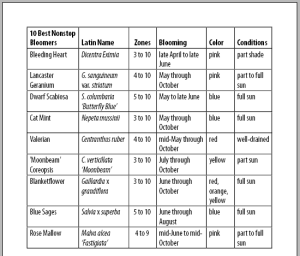 Have you tried importing from Excel into InDesign? In Book Design Made Simple we walk you through importing tables from Word, but importing a spreadsheet from Excel is a bit different so we’ll walk you through it here. And, because spreadsheets and tables rarely import into InDesign looking like they did in Excel and Word, we’ll give you a few tips on the easiest way to get started.
  How can you determine whether an image file is high enough resolution to use in your book? That’s a question I get asked all the time! Images should be at least 300 ppi (pixels per inch) at the size they’ll be printed at— and that’s where most people need help. How do you figure out the size of an image, and whether or not it’s suitable for printing?

